

How I Finally Learned to Rotate
Updated: Oct 1
Core-Tex Reactive Trainer review
Thirty years of swing tips told me to turn. Nobody could make me feel it. A 30-inch platform from San Diego did it in about two minutes, and it changed how I think about the move every golfer is chasing.
Bottom line up front
Core-Tex is not a swing aid and it is not a balance board. It is a reactive platform that tilts, slides and rotates at the same time, which forces your hips, spine and shoulders to shift, turn and tilt together the way a real swing does. For golfers who feel stiff, slide instead of turn, or spin out with no pressure shift, it is the most direct way we have found to feel correct rotation without thinking about positions.
The move no coach can hand you
I have been told to "turn" by every instructor I have paid, every magazine I have read and every YouTube pro who has ever stood in front of a range net. I believed I was doing it. I felt my hips go. I felt my shoulders go. I finished facing the target most of the time.
Then I saw myself on video. My hips slid toward the target like a man trying to squeeze past someone in a movie theater row. My shoulders stayed level. The club was stuck behind me, and my hands had to save it. The contact problems I had blamed on my irons for a decade were right there in the footage.
That is the gap nobody talks about enough. What rotation feels like and what is actually happening in your swing are rarely the same thing. Most of us are sure we are turning. The camera usually disagrees.

What real rotation actually is
Here is the part that took me far too long to understand. Rotation is not just spinning your hips. A good golf turn is three things happening together, and most amateurs only manage one or two of them.

The sliders are missing step two. The spinners are missing step one. Almost everyone is missing step three. And here is the frustrating truth: you cannot drill these one at a time and bolt them together. They have to happen at once, which is exactly why position-based instruction so often falls flat.
Why this matters more than your next driver
This is not only about ball striking. Your body will find a way to hit the ball whether it moves well or not, and the workarounds are where the damage happens.
The research on this is not subtle.
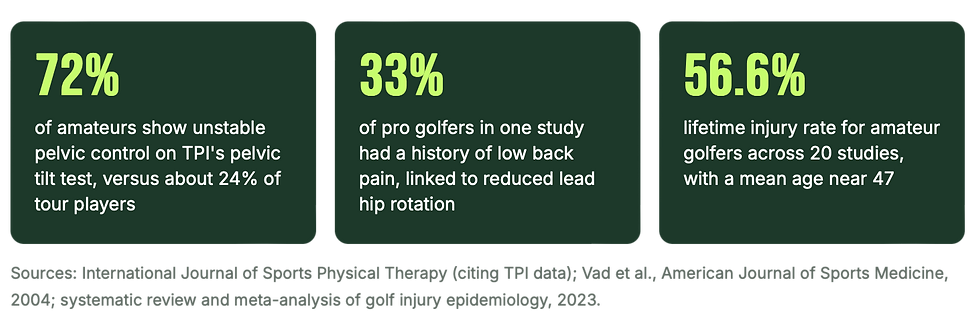
Read that middle number again. In a study of professional golfers, the players with back trouble were the ones whose lead hip did not rotate well. When the hips will not turn, the lower back does the turning for them. That is a trade most of us made years ago without knowing it.
If you are north of 50, like most of the golfers who read this site, you already know the feeling. The first three holes are a warm-up whether you like it or not. Your turn gets shorter every season. You lose a few yards and blame the ball.
What golfers have tried up to now
Golfers have been chasing a better turn for as long as there has been a golf fitness industry. I have tried most of these. They all do something. None of them did the whole job.

Notice the pattern. Every cheap tool trains one plane of motion. The only option in the list that reliably hits all three at once is a qualified human standing next to you, and that gets expensive fast. That gap is exactly where Core-Tex lives.
What Core-Tex is, and where it came from
Core-Tex was invented by Anthony Carey, a San Diego biomechanics and corrective exercise specialist and author of The Pain-Free Program. His story goes that he was standing at a squat rack one day and realized that straight-line, front-to-back exercise was not using much of what the human body can actually do. His first prototype was an industrial fan turned upside down, with a piece of plywood on top and caster wheels underneath.

The finished product is a 30-inch platform sitting on a dome and ball-transfer base. The patented design lets the surface tilt, slide and rotate a full 360 degrees at the same time. That combination is the whole point. Carey has been clear that it is not a balance device. It is built to create unrestricted three-dimensional movement, and to make your nervous system react to it.
Core-Tex calls this "bottom-up" movement. Instead of you moving your body over a still floor, the floor moves under you, and your hips, spine and shoulders have to organize themselves in response. Nobody has to tell you where to put anything. Your body sorts it out.
Who is using it
This is not a late-night infomercial product that showed up last spring. Core-Tex has been in physical therapy clinics, hospitals, universities and pro training rooms for years, and the company says hundreds of professional sports franchises use it. It carries logos from the MLB, NFL, NBA and NHL on its site, and Core-Tex is a Titleist Performance Institute Alliance member.

In golf, it has landed where serious members train. St. Andrews Country Club uses it, and its fitness director credits the platform with improving members' balance, stability and rotational strength. It has also shown up at clubs like Boca West, John's Island and Mission Hills, and it drew coverage in the Orlando Sentinel during the PGA Merchandise Show.
Three weeks on the platform
I used the Core-Tex at home, mostly in the mornings and before rounds. I did not overhaul my swing, take lessons or change equipment during the test. Here is how it went.
Day 1: The first two minutes
Assembly took under five minutes. No tools, just drop in the ball transfers and set the dome. The platform sits about seven inches off the floor, and I held the handrail the first time up.
I started a gentle hip turn, the kind I would do at the range to loosen up. The platform went with me, and then it did something I did not expect. It tilted. It slid slightly toward my lead side. My trail shoulder dropped on its own. For about ten seconds I was doing the move I had been trying to make for years, and I had not thought about any of it.
The official Core-Tex line is that golfers say "I can't believe how much better I can turn." I did not say that out loud. I did say something my wife asked me not to repeat.
Week 1: Finding the lead side
Two to five minutes a morning. What surprised me was how clearly the platform showed me my habits. When I slid, it slid away from me and I lost my footing. When I spun without shifting, it stalled. The only way to keep it moving smoothly was to shift, turn and tilt together. It is honest feedback, and it is immediate.
My lower back, which usually needs a hot shower and three holes to settle down, felt looser by midweek.
Week 2: The first tee feels different
I started using it as my pre-round warm-up. Five minutes in the garage, then off to the course. The first tee shot is usually where my stiff back talks me into a short, armsy swing. This time the turn felt available right away. I was not "loosening up by hole five." I was ready on hole one.
Week 3: Seeing it on camera
I filmed myself again. The slide was not gone, but it was noticeably smaller, and my trail shoulder was working down instead of level. Contact was more centered and the club felt like it was in front of me instead of stuck behind. None of this came from a swing thought. It came from my body learning what the move felt like and choosing it on its own.
We did not put the test on a launch monitor, so we are not going to give you yardage numbers. Core-Tex has published its own Trackman before-and-after demo, which shows gains in distance, clubhead speed and pelvic turn after a ten-minute session, and it is worth watching on their site. What we can tell you is how it felt, and it felt like the first time a piece of equipment taught me something instead of asking me to remember something.
What it feels like, in plain English
If you have ever been fitted for a driver and watched a fitter swap a shaft and suddenly the ball just goes, you know the feeling of something clicking without effort. Core-Tex is that, for your body. You step on, you start turning and the right move happens before you have time to overthink it.
It is also humbling. The platform does not care about your handicap. If your hips do not want to go somewhere, you will find out in about four seconds.
Who it's for, and who should skip it

The details that matter
The unit weighs about 55 pounds and supports users up to 350 pounds. It stores flat against a wall with the dome leaned against the base. Occasional maintenance keeps the ball transfers smooth and quiet. Core-Tex includes access to 25-plus golf applications covering hip mobility, thoracic rotation, shoulder mobility, core stability, balance and rotational power, plus a library of more than 100 video guides.
The current Golf Performance Package is $699 and includes the Reactive Trainer, a free Core-Tex Sit (a $97 seated trainer for posture and low back), free shipping, a one-year manufacturer's warranty and a 30-day money-back guarantee. If it does not work for you, you send it back.
The GolfGrade verdict
What we liked
Trains shift, turn and tilt at the same time, which almost nothing else does
You feel the difference in the first two minutes
No swing thoughts required, so it transfers to the course
Doubles as a first-rate pre-round warm-up
Proven in PT clinics, pro training rooms and top clubs
30-day guarantee takes the risk out
What to know
$699 is a serious purchase for a training tool
At 55 pounds, it's not something you toss in the trunk
It improves how you move, not your swing mechanics directly
Results come from regular use, not one session
Most of us have spent more on a driver that gave us five yards than Core-Tex costs, and the driver never taught us how to turn. If rotation is the missing piece in your swing, and for most amateurs it is, this is the most direct route to feeling it that we have tested. It earns a 9.1








Comments