

OnePuttPro Review: The Data That's Been Missing From Your Practice Green
Updated: Jul 9
Most golfers have been practicing the wrong things for years and have no idea. This device changes that...
Bottom Line Up Front
OnePuttPro is the first consumer putting device that gives you live angles at address before you even start your stroke...then captures 6 metrics per putt and tells you exactly what to fix. If you've ever wondered why your putting practice isn't translating to the course, this is where the answer lives.
The uncomfortable truth about how golfers practice putting
Here's what nobody wants to say out loud: most golfers have been practicing the same technical mistakes for years, getting better at doing the wrong thing, and calling it consistency.
It's not their fault. Until very recently, there was simply no affordable way to see what was actually happening during a putting stroke. You felt the putt. You watched it miss. You tried again. Repeat for decades.
The traditional model for putting instruction is rooted in feel, repetition, and a coach's trained eye. A good instructor can see a lot. But nobody, not even the best coach in the world, can see your exact face angle at impact, measure your loft at address, or calculate your tempo ratio in real time, stroke after stroke, for a two-hour practice session.
That gap between what you feel and what's actually happening is where strokes disappear.
"The biggest problem isn't that golfers can't putt. It's that they're practicing mistakes and getting better at them."
— Chase Mercer, Golf Instructor @ VC GOLF

The data backs this up. According to SAM PuttLab research cited by multiple putting coaches, face angle at impact accounts for 83–93% of a putt's starting direction. Yet the average amateur golfer carries a face angle error of 3 to 5 degrees — enough to miss the hole from 10 feet on a straight putt. Good amateurs get it down to about 2 degrees. Tour players are closer to 1.
That's the gap. And for most golfers, it's completely invisible.

What OnePuttPro actually is...
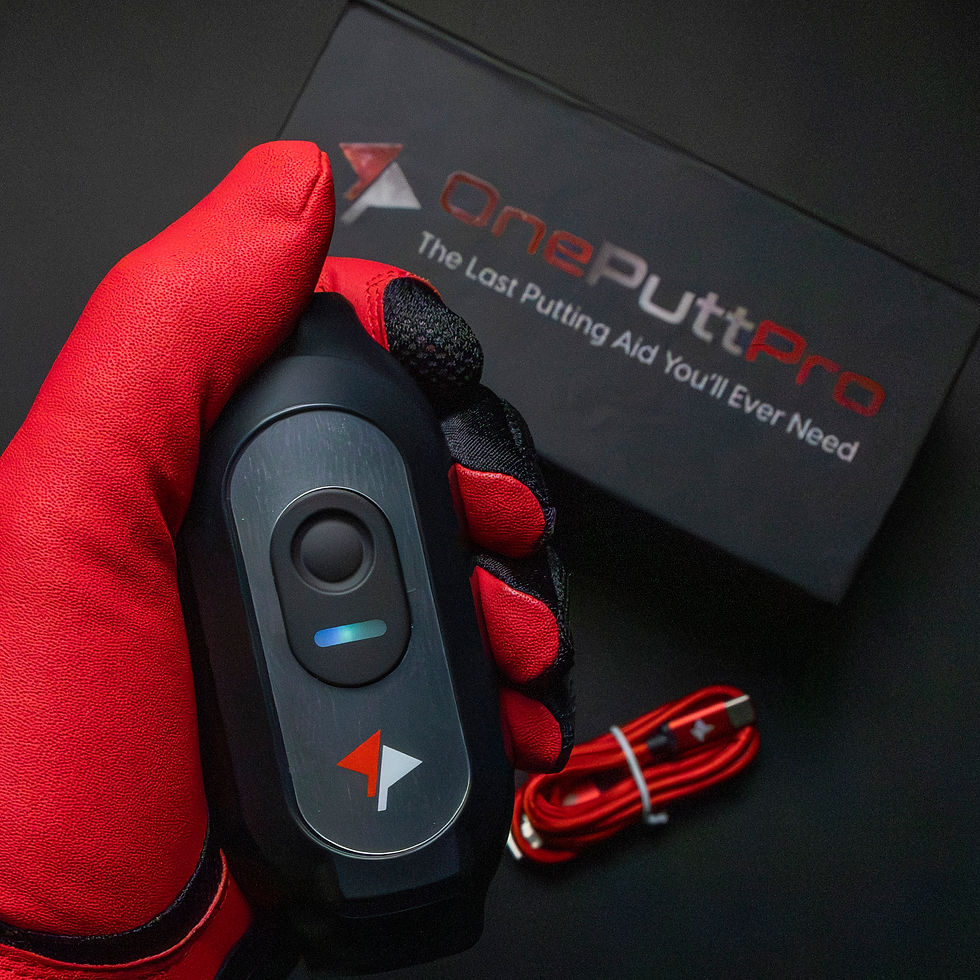
OnePuttPro is a smart putting device that clips directly under your putter grip and pairs with an iOS or Android app. It captures your stroke in real time, displays live data on your phone, and syncs to a web-based dashboard where you can track your progress across sessions, weeks, and months.
The hardware is compact and designed to stay attached during practice without affecting your natural grip or feel. Setup is straightforward: attach the sensor, open the app, calibrate, and start putting. There's no footage to analyze, no wires, no external cameras.
What sets OnePuttPro apart from other putting analyzers isn't just the data it captures. It's when it captures it. Most devices tell you what happened after the ball left the face. OnePuttPro shows you live angles at address, before you pull the putter back. That's a fundamentally different kind of feedback.

The 6 metrics — and why each one matters
This is where things get interesting. OnePuttPro doesn't give you a vague score or a colored light. It gives you six specific, actionable numbers — and then tells you what to do about them.

🔑 Each metric comes with built-in guidance; OnePuttPro's "Putting 101" coaching tips that explain what your numbers mean and what adjustments to make.
It's not just raw data; it's a feedback loop that mimics having an instructor standing next to you on every stroke.
Why data changes everything about how putting is taught
For most of golf's history, the feedback loop has been brutally simple: the ball either goes in or it doesn't. If it misses, you guess at why. You try something different. You repeat until something works — or until you give up and buy a new putter.
The data revolution that transformed the full swing — launch monitors, ball tracking, Trackman — largely bypassed putting. Putting was considered feel-based, intuitive, something you couldn't really quantify. You either had it or you didn't.
That was always wrong. The data was just inaccessible.
Professional coaches who use high-end lab systems like SAM PuttLab have known for years that putting is deeply technical...that face angle, loft, tempo, and impact location are measurable, coachable, and directly connected to outcomes. They've been using this data to transform Tour players' strokes for decades. But the equipment cost thousands of dollars and required a specialized fitting session in a controlled environment.
OnePuttPro brings that same analytical layer to a $397 device you can use on your putting mat at home.
"I found a putter I'd owned for a while but rarely used, and the numbers showed it was clearly the best fit for me. I took it to the course and played the owner at his home course, winning by three strokes."
— OnePuttPro verified buyer
This is the shift that matters. When you know your numbers, you stop guessing. You stop blaming the green, the read, the grip, the putter. You identify the actual problem — face angle at impact is 2.3° open, tempo ratio is 1.6:1 instead of 2:1 — and you work specifically on that. Practice becomes purposeful. Improvement becomes measurable.
And critically: you know when you've fixed it, because the number changes.
What happens when you actually know your numbers?
The behavioral change that comes from data-driven practice is difficult to overstate. When golfers start tracking their actual metrics, three things tend to happen.
First, they find out their feel is lying to them. The most common discovery is that putts that "felt" square were open by 1.5–2 degrees — consistently. The stroke they'd been practicing for years had a structural flaw they never knew about. This is both sobering and liberating: the problem wasn't talent or touch, it was an invisible technical error that can be corrected.
Second, they identify patterns in their misses. When you have data from 50, 100, or 500 putts, patterns emerge that no coach could identify from a single session. A golfer who misses putts right on faster greens but left on slower greens might have a face angle that's consistently borderline — just inside the margin on slow surfaces, just outside it on fast ones. That's the kind of insight that turns a "bad green day" into a specific, fixable problem.
Third, they practice with a target instead of a feeling. Instead of hitting putts until things feel good, they hit putts until a specific metric reaches a specific benchmark. Achieve a neutral face angle on five consecutive putts. Keep tempo ratio between 1.9 and 2.1 for ten straight strokes. This kind of structured practice is what Tour players do. It's what college programs do. And it's now available to every golfer.
How it compares to the competition
Feature | OnePuttPro ($397) | Blast Motion ($149) | CAPTO EZ ($620+) | PUTTR ($599) |
Live angles at address | ✓ Exclusive | ✗ | ✗ | ✗ |
Face angle at impact | ✓ | ✓ | ✓ | ✓ |
Loft angle | ✓ | ✗ | ✓ | ✗ |
Lie angle | ✓ | ✗ | ✓ | ✗ |
Tempo ratio | ✓ | ✓ | ✓ | ✗ |
Acceleration at impact | ✓ | ✗ | ✓ | ✗ |
Built-in coaching tips | ✓ "Putting 101" | ✗ | ✗ | ✓ |
Web dashboard / long-term tracking | ✓ | ✓ | ✓ | ✓ |
Standard + Pro skill levels | ✓ Custom calibration | ✗ | ✗ | ✗ |
Use on-course or indoor | ✓ | ✓ | Lab only | ✓ |
The Blast Motion is the clear budget alternative but at $149 it captures far fewer metrics and lacks loft, lie, and acceleration data. The CAPTO is the professional gold standard used by Tour coaches, but at $620+ it's priced for coaching facilities, not individual golfers. OnePuttPro sits squarely in the performance sweet spot: Tour-level data categories at a consumer price point, with built-in guidance that the CAPTO doesn't offer.
Who this is actually for
OnePuttPro's marketing says "beginners to pros." That's technically true but not the most useful framing. Here's a sharper breakdown.
It's most powerful for golfers in the 8–20 handicap range. This is the group that putts enough to have repeatable patterns — and has enough technical inconsistency that data will reveal something actionable immediately. Lower handicappers often already know their tendencies; higher handicappers may benefit more from green reading and distance work before getting into stroke mechanics.
It's ideal for golfers who practice without a coach. If you practice putting regularly but have no external feedback, you are very likely reinforcing errors. OnePuttPro is the closest available substitute for having a qualified coach watching every stroke.
It's essential for anyone who's changed putters multiple times and still feels inconsistent. One of the device's most underrated applications is putter fitting — discovering which putter in your bag produces the best face angle numbers for your natural stroke. Several reviewers report discovering a putter they'd previously discarded was actually their best-performing option.
It benefits coaches and teaching professionals who want to bring data into lessons without investing in lab equipment.
Our Verdict
OnePuttPro represents a genuine shift in how amateur golfers can understand and improve their putting. The combination of live at-address feedback, six comprehensive metrics, built-in coaching guidance, and a long-term tracking dashboard puts professional-grade analysis in the hands of everyday golfers for the first time at a realistic price point.
The traditional model: feel it, watch it miss, adjust, repeat...has a ceiling.
This doesn't. When your practice is driven by data, improvement is no longer a guess. It's a process.
Strengths
Only device with live angles at address
Six metrics — the most comprehensive consumer option
Built-in Putting 101 coaching tips per metric
Web dashboard for long-term session tracking
Works on-course and indoors
Standard and Pro calibration modes
Priced $220+ less than nearest full-feature competitor
Considerations
Requires smartphone to operate
No green-reading or break analysis
Results most actionable for mid-handicap range
Newer device — longer-term durability data still building
READY TO KNOW YOUR NUMBERS?

GolfGrade independently evaluates golf equipment and training technology based on available product specifications, published research, and manufacturer data. This article may contain affiliate links — if you purchase through our links, GolfGrade may earn a commission at no additional cost to you. Our editorial opinions are never influenced by affiliate relationships. Statistical data on face angle and strokes gained sourced from SAM PuttLab research, PrimePutt, and published putting instruction literature.







Comments