

Performance Golf RS1 Putter Review: Does Forward Axis Weighting Actually Work?
Bottom Line Up Front
The Performance Golf RS1 is one of the most genuinely innovative putters to hit the market in years. Designed by veteran club maker Chris McGinley — who has worked with 11 world # 1 players over three decades — the RS1 introduces Forward Axis Weighting, a physics-based approach to solving a problem that 95% of putters have been ignoring for 125 years: face drift.

If you miss putts left and right without understanding why, the RS1 is worth serious consideration. Priced at $399 with a 365-day money-back guarantee, the risk is almost entirely on Performance Golf's side, not yours.
Who Is This Putter For?
The RS1 is designed for golfers who:
Miss putts inconsistently — left one stroke, right the next — and can't figure out why
Struggle with "yips" or overactive hands through impact
Have tried blade and mallet putters without finding a permanent solution
Want a premium, well-engineered putter that's backed by real science, not marketing fluff
Are willing to invest in their short game the same way they invest in their driver

It's not ideal for golfers who are firmly committed to a deep arc stroke and prefer a traditional blade feel above all else. But for the vast majority of recreational players and even many competitive amateurs, the RS1 addresses the root cause of most missed putts.
The Problem: Face Drift
Before reviewing the RS1, it's worth understanding the problem it's solving — because it's a real one.
In a conventional putting stroke, the putter head travels on a slight arc. As it moves away from the ball, the face naturally wants to open. As it comes through to impact, it has to rotate back to square at precisely the right moment. Miss that timing window — even slightly — and you miss the putt.

This is what Performance Golf calls face drift, and it's not a technique problem. It's a physics problem, baked into the design of virtually every putter ever made.
Why? Because in 95% of putters, most of the head weight sits behind the shaft axis. That rear weighting creates rotational torque that pulls the face off-path during the stroke. You're fighting the putter every time you putt, even when it feels smooth.
The Solution: Forward Axis Weighting
The RS1's central innovation is shifting where the weight lives.
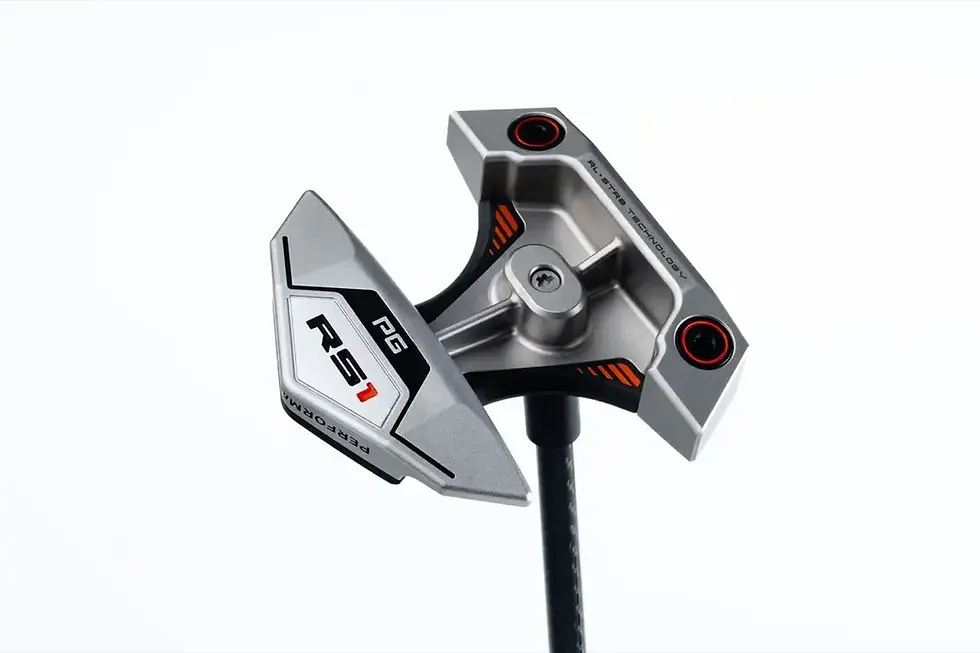
Instead of loading mass behind the shaft, the RS1 places 75% of its 360g head weight in front of the shaft axis. This shifts the center of gravity forward, which changes how gravity acts on the face throughout the stroke.

The result: rather than the face wanting to drift open on the backstroke, gravity keeps it squarer to the target line — passively, automatically, without any conscious effort from you.
Performance Golf's tagline for the RS1 is "Pull it back, let it fall." That's not marketing poetry. It's a literal description of how the putter works. The forward weight distribution means gravity pulls the head through the ball on the correct path, rather than fighting your tendency to open or close the face.
This is fundamentally different from zero-torque mallets (like Ping's putter lineup), which achieve neutral balance by distributing weight evenly around the shaft. Neutral means the putter doesn't actively fight you — but it also doesn't actively help you. The RS1 is designed to use gravity as a corrective force.
The 8 Features Working Together
The RS1 isn't just a single engineering trick. McGinley built 8 design elements into the putter that all reinforce the same goal: keeping the face square longer.
1. Forward Axis Weighting (75% Front)
The foundational feature. 75% of the 360g head sits ahead of the shaft axis, pushing the center of gravity forward.
2. Face Down Balance (FDB)
When you balance the RS1 on your finger at the shaft, the face points downward — not skyward like a conventional mallet. This "face down" balance is the physical expression of forward weighting, and it's what actively counteracts your natural tendency to open the face during the stroke.
3. Square-to-Square 74° Lie Angle
Standard putters use a 69–70° lie angle. The RS1 sits at 74°, which is 4° more upright. A more upright lie angle shortens the natural arc of the stroke. Less arc = less face rotation = less room for timing errors.
4. 10-Piece "Hammerhead" Construction
The RS1 is built from a CNC-machined steel face, a lightweight carbon composite crown, and an aluminum T-Wing tail — plus seven other precisely-specified components. Every gram of every material was selected specifically for what it contributes to the overall weight distribution. This is not a cast putter with a paint job.
5. Patented Dual Pistol Grip
The RS1 ships with an exclusive dual-sided pistol grip — flat on the top and bottom, curved on the sides. This design reduces grip pressure and limits overactive hand movement through the stroke. Works with conventional, cross-hand, and claw grip styles.

6. Face Forward Design
The shaft sits behind the striking face, giving you a completely unobstructed view of the entire face at address. No hosel, no shaft blocking your eye line — just the face and the ball.
7. T-Trac Alignment System
Three parallel lines run from tail to face, meeting a perpendicular line at the face. Clean, easy-to-read alignment that helps you set up square on every putt.
8. T-Wing Tail
The sculpted T-shaped rear section is designed to be as light as possible. Every gram saved from the tail gets redistributed forward, directly driving the Forward Axis Weighting effect.

Bonus: Sculpted Sole Relief
Three-zone sole relief with rounded leading and trailing edges means the putter glides through the stroke without snagging on the turf. A small detail with real impact on stroke consistency.
Build Quality: Premium, Not Pretend
The RS1 doesn't just claim premium — it delivers it. The CNC-machined 303 stainless steel face provides consistent feel across the entire striking surface. The carbon composite crown keeps weight out of the rear while giving the putter a solid, substantial feel in hand.
At 360g, the head weight is substantial — slightly heavier than the average putter. Golfers who have tested it report that this weight, combined with the forward distribution, makes the putter feel almost self-propelled through the stroke. That's not an accident. That's the physics working.

The finish is a clean premium black — understated and elegant, not flashy. It looks like a serious piece of equipment, because it is one.
How It Compares to the Competition
Feature | RS1 ($399–$429) | Zero-Torque Mallets ($449–$499) | Traditional Blades ($449–$469) |
Forward Axis Weighting | ✅ 75% weight forward | ❌ | ❌ |
Face Down Balance | ✅ Active face control | ❌ Passive/neutral | ❌ |
Face Drift Elimination | ✅ Gravity-assisted | Partial | Player-dependent |
Lie Angle | 74° | 69° standard | ~70° |
Stroke Improvement | ✅ Built-in | ❌ | ❌ |
Guarantee | 365 days | 30 days | Varies |
Price | $399–$429 | $449–$499 | $449–$469 |
The RS1 is notably less expensive than its direct competitors in the premium mallet category — while offering a substantially longer guarantee period and, by Performance Golf's argument, more active technology.
RS1 vs. RS1+: Which Should You Choose?
Performance Golf offers two versions:
RS1 ($399) — Stepless steel shaft, Dual Pistol Rubber grip RS1+ ($429) — 15mm low-torque graphite shaft, Dual Pistol Polyurethane grip
Both share the same head, lie angle (74°), loft (3.5°), and length (35"). Both are available in right and left hand.
The RS1+ is aimed at golfers who prefer the dampened feel of graphite and want slightly more refinement in the grip material. For most recreational golfers, the standard RS1 at $399 is the smarter starting point — especially given the 365-day guarantee lets you evaluate the technology thoroughly before any commitment feels real.
The Robot Testing
Performance Golf put the RS1 on a putting robot to remove all human variables and test the Forward Axis Weighting claim head-to-head against a traditional mallet.
Key findings:
Face stability: The RS1 face stayed markedly squarer through the arc compared to the traditional mallet, which showed visible face drift on the backstroke.
Arc tightness: The 74° lie angle produced a visibly tighter swing arc than a standard 70° putter under identical stroke conditions.
Consistency: Over 20 identical putts, the RS1 produced tighter ball groupings and straighter roll patterns.
Gravity effect: When both putters were pulled back and released (no human input), the RS1's forward-weighted head accelerated through the ball more consistently.
Robot testing removes a golfer's compensations, timing, and muscle memory from the equation. What it reveals is how the putter behaves when left to its own physics — and the RS1's physics are working in the golfer's favor.
What Golfers Are Reporting
Early testers across various skill levels are noting consistent themes:
Reduced grip pressure — the Dual Pistol grip naturally encourages lighter hands
Improved lag putting — the consistent path and face stability reduces three-putts
Confidence at address — the Face Forward design and T-Trac alignment combine to make setup feel definitive, not guesswork
Faster adaptation — most golfers report that the stroke adjustment required is minimal; the putter guides you rather than demanding a technique overhaul
Who Designed It (And Why That Matters)
Chris McGinley isn't a brand figurehead. He's a working club engineer with 30+ years of hands-on design experience. His resume includes working directly with 11 world #1 players during some of the most competitive eras in professional golf history.
The RS1 is described as the putter McGinley always wanted to build — a design that addresses the fundamental physics of putting rather than adding features that look impressive on a spec sheet. Forward Axis Weighting isn't a new marketing concept for Performance Golf. It's an engineering principle McGinley has been developing throughout his career.
That pedigree matters when you're evaluating whether a novel technology is legitimate innovation or clever advertising.
The Verdict
The Performance Golf RS1 is a legitimately innovative putter built on a sound engineering foundation.
The Forward Axis Weighting concept isn't gimmicky — it's a logical response to a real mechanical problem that most golfers have been compensating for without realizing it.
The 8-feature system is cohesive. Every element serves the same purpose. The build quality is genuinely premium. The price is competitive with — and below — many putters in its category. And the 365-day guarantee means you have an entire season to decide if it works for your game.
If you've been cycling through putters looking for the one that feels right, the RS1 asks a different question: what if the feeling of "right" has been working against you all along?
Pros
Genuinely novel Forward Axis Weighting technology
Gravity-assisted stroke reduces timing dependence
74° lie angle shortens arc, reduces face rotation
Premium 10-piece construction with CNC-milled face
Patented Dual Pistol grip quiets hand action
Competitively priced vs. premium competition
Industry-leading 365-day money-back guarantee
Conforms to the Rules of Golf
Cons
Adjustment period required — feel differs from conventional mallets
35" fixed length (not adjustable)
Limited color/finish options (premium black only)
Head-heavy feel may take a round or two to calibrate distance control
Specifications
Spec | RS1 | RS1+ |
Price | $399 | $429 |
Head Weight | 360g | 360g |
Weighting | 75% Forward Axis | 75% Forward Axis |
Lie Angle | 74° | 74° |
Loft | 3.5° | 3.5° |
Length | 35" | 35" |
Face | CNC-machined steel | CNC-machined steel |
Crown | Carbon composite | Carbon composite |
Tail | CNC aluminum T-Wing | CNC aluminum T-Wing |
Shaft | Stepless steel | 15mm low-torque graphite |
Grip | Dual Pistol Rubber | Dual Pistol Polyurethane |
Hands | RH / LH | RH / LH |
Finish | Premium black | Premium black |
Guarantee | 365-day | 365-day |
Conforms to Rules | Yes | Yes |
Free shipping included. 365-day money-back guarantee — no questions asked.
GolfGrade independently evaluates golf equipment based on available specifications, manufacturer data, and testing documentation. This article contains affiliate links — if you purchase through our links, GolfGrade may earn a commission at no extra cost to you. Our editorial opinions are never influenced by affiliate relationships.







I'm 78 years old been around golf my whole life you like all the other's are about greed profits before anything.
400.00 for a single golf club is sickening, good luck
Buy the way I'm a club maker so I know a little about pricing