

LM1 LAUNCH MONITOR MAKES TOUR-LEVEL SWING ANALYSIS ACCESSIBLE FOR ALL GOLFERS
Category Deep Dive: Launch Monitors
Bottom Line Up Front
The LM1 isn't a discount version of an existing launch monitor — it's Shot Scope building an entirely new category around what golfers actually said they wanted: real numbers, a setup that doesn't require a manual, and zero subscription fees. It skips the spin data and dispersion circles that lower-tier radar units get wrong anyway, and instead nails the five numbers that drive real improvement.
The Problem With Practicing Blind
Most golfers hit range balls without knowing a single real number. You watch the flight, guess the yardage, and build your entire distance gapping on feel. That's how a golfer ends up carrying two clubs he thinks are 15 yards apart when they're actually 4.
The launch monitor category solved this years ago — for golfers willing to spend $600, $6,000, or $60,000 to get there. Shot Scope, the Scottish golf tech brand best known for its GPS watches and on-course shot tracking, built the LM1 to answer a simpler question: what does a golfer actually need to know to get better, and how cheap can that get?
The answer, according to the brand's first launch monitor, is five data points, a 10-second setup, and a $199 price tag with zero subscription attached.
Why Shot Scope Built This
Price is the headline, but it's not the interesting part of this story. The interesting part is that Shot Scope didn't set out to build a cheaper version of an existing product — it spent six weeks at the range listening to golfers before writing a single spec, and came away convinced the entire category was solving the wrong problem.
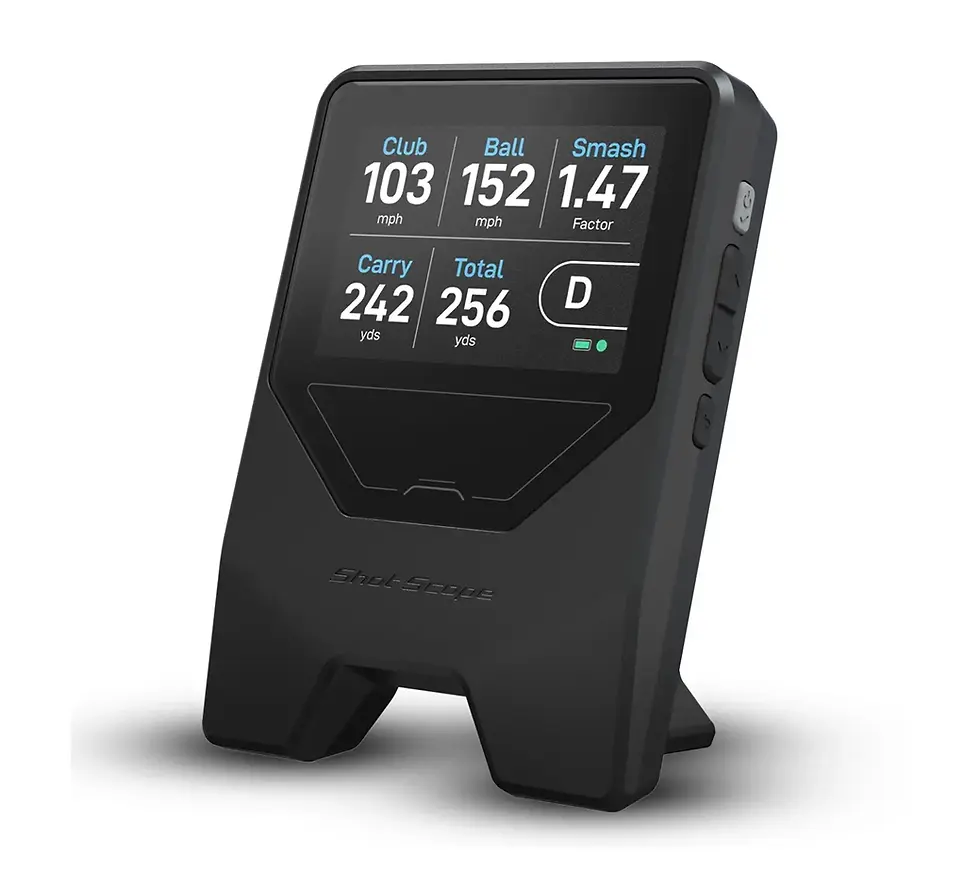
Founded in Edinburgh in 2014, Shot Scope built its name on GPS watches, laser rangefinders, and a shot-tracking ecosystem that has quietly logged millions of data points from real rounds. The LM1 is the company's first launch monitor — and rather than chase the optics-and-camera arms race that Foresight, Trackman, and Rapsodo are fighting at the top of the market, Shot Scope's engineering team, led by a CEO with an avionics and military hardware background, aimed at a gap nobody else was defending.
What they heard on the range, over and over, was some version of the same complaint: golfers wanted real data, but every option came bundled with a subscription they weren't sure they needed, a setup process they didn't trust themselves to get right, and a wall of metrics they couldn't translate into anything actionable. So Shot Scope built toward a different target entirely — a category it now calls the mini launch monitor segment: something small enough to live permanently in a golf bag, simple enough to trust without a manual, and priced low enough that the decision to buy one stops being a decision at all.
That simplicity took real engineering to earn. Doppler radar that reads a smooth 90 mph swing reliably is one problem. Doppler radar that stays accurate above 110 mph, where mishits, steeper attack angles, and faster closure rates all start breaking cheaper sensors, is a much harder one. Shot Scope's team spent roughly nine months solving specifically for that upper range, chasing swing-speed milestones one at a time until the LM1 could read a scratch golfer's driver as cleanly as a beginner's 7-iron.
The market noticed. The LM1's first production run sold out before it officially shipped, it was one of five products selected for the ING Media Showcase of New Products at the 2026 PGA Show, and Plugged In Golf named it Best of Show outright.
For a company that had never built a launch monitor before, that's not luck — it's what happens when you build the product golfers actually described wanting.
"We call it the mini launch monitor segment."— David Hunter, CEO, Shot Scope


What It Actually Measures
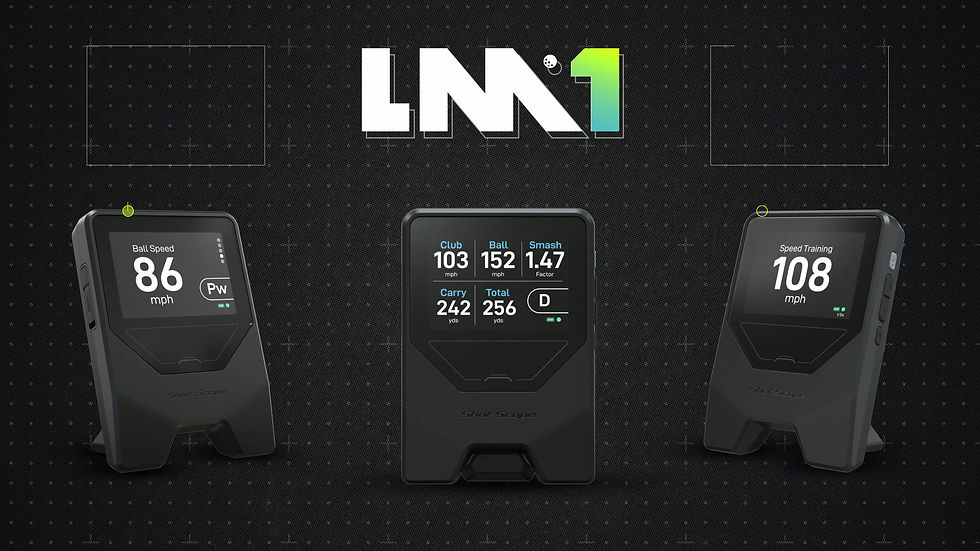
The LM1 doesn't try to be a simulator. It strips the category down to the numbers that change how you practice.

Setup: Power On, Hit In Under a Minute
Shot Scope lists the LM1's power-on-to-first-shot time at 25 seconds. Reviewers who've clocked it found it's usually faster than that in practice — closer to 10 seconds once you know the four-button sequence.
There's no phone to pair, no tripod to level, and no calibration screen. Place the unit roughly a driver's length (Shot Scope recommends 55 inches) behind the ball, select your session type — Speed Training, Practice Range, or On Course — pick your club with the up and down buttons, and start hitting. The 3.5-inch color screen puts your numbers up before you've finished your follow-through.
It also forgives imperfect placement. Testers who set it anywhere from 44 to 90 inches behind the ball still got consistent readings with a driver. The one habit it demands: you have to manually change clubs on the unit itself if you want that data to sort correctly once it lands in the app.
Accuracy: The Number That Actually Matters
A cheap launch monitor is worthless if the numbers lie to you. This is where the LM1 separates itself from the $200-$500 crowd it competes with.
In side-by-side testing against a Foresight GCQuad and a Full Swing KIT — launch monitors that retail for tens of thousands of dollars — the LM1's iron shots landed within one yard of the premium units roughly 8 times out of 10. Of the outliers, most were within two to three yards. Ball speed and club speed readings were rarely off by more than a single mile per hour. Driver mishits showed slightly larger gaps, in the 5-7 yard range, but centered strikes tracked just as tightly as the irons.
What the LM1 deliberately leaves out is just as important. It doesn't report spin, launch angle, or dispersion — the stats that budget radar units routinely get wrong. Shot Scope's decision to cut them rather than fake them is the reason the numbers it does show hold up.
Build, Durability & The App
At 4" x 5.5" x 1" and under 11 ounces, the LM1 lives in a side pocket without anyone noticing it's there. It's rated IPX3, so a light rain during a range session isn't a dealbreaker, and the rechargeable USB battery is reported to run several full sessions between charges.

Every session syncs over Bluetooth to the free Shot Scope app — no subscription, ever. Inside the app, shots sort by club, showing your min, max, and average carry and total distance for every stick in the bag. For a golfer who's never had real numbers before, that alone can reshape how you manage a course: knowing your true 7-iron number, not your hopeful one, changes club selection on the tee box.
The trade-off is that the on-device experience and the app experience are two different products stitched together. You still have to remember to select the right club on the unit for the app data to file correctly, and the speed-training numbers don't currently sync or aggregate the way range-session data does.
How It Stacks Up
The LM1 isn't trying to compete with simulator-grade units. It's built for a specific golfer: one who wants honest practice data without paying for a home sim setup or a monthly bill. Here's where it lands against the field it actually competes in.

If your goal is a home simulator, the R10 or MLM2PRO earn their higher price. If your goal is knowing your real numbers every time you go to the range, the LM1 does that job for a third of the cost.

Who Should Buy the LM1
If you're chasing simulator golf at home, look at the Garmin R10 or Rapsodo MLM2PRO instead — that's not what this unit is built for. But if you just want to stop guessing on the range, dial in real numbers with every club in the bag, and never see a subscription charge, the LM1 is about as close to a no-brainer as this category gets.
Frequently Asked Questions
Does the LM1 work indoors?
Yes. It's built for both indoor and outdoor use, and testers reported consistent readings hitting into a net.
Do I need a subscription to use the app?
No. The Shot Scope app is free with no recurring cost, and every LM1 metric is included.
How much space do I need to use it?
Shot Scope recommends placing it about 55 inches behind the ball. Testing showed reliable readings from as close as 44 inches out to 90 inches.
Can the LM1 run a golf simulator?
No. It reports club speed, ball speed, smash factor, carry, and total distance only — it doesn't project ball flight onto a screen or connect to simulator software.

GolfGrade independently evaluates golf equipment based on available specifications, manufacturer data, and testing documentation.








Comments